Domestic Abuse Therapy: Maple Ridge & Beyond
You Are Not Alone
If you're navigating the impact of domestic abuse — whether it's happening now or happened in the past — please know this: what you experienced was not your fault, and you deserve support that is compassionate, informed, and centered on your safety.
Domestic abuse counselling offers a confidential, judgment-free space to process what you've been through, understand its impact, and begin to reconnect with your sense of safety, strength, and self. This work is held gently, and always at your pace.

What Domestic Abuse Counselling Can Support
Just as roots can be damaged by conditions beyond their control and still find a way to grow again, healing after abuse is possible — even when it feels far away right now. Domestic violence counselling and support can help with:
-
Processing past or current experiences of abuse
-
Understanding the emotional, psychological, and physical impact of domestic violence
-
Rebuilding self-esteem, trust, and a sense of safety
-
Trauma symptoms, including anxiety, hypervigilance, and dissociation
-
Navigating the impact of coercive control and emotional abuse
-
Supporting children who have witnessed or experienced domestic abuse
-
Safety planning and next steps, at your own pace and on your own terms
-
Rebuilding a sense of identity and confidence after leaving an abusive relationship
Understanding the Different Forms Abuse Can Take
Domestic abuse doesn't always look like what you might expect, and it isn't always physical. It can show up as:
-
Physical abuse — hitting, restraining, or other physical harm or intimidation
-
Emotional and psychological abuse — put-downs, manipulation, gaslighting, or isolation from friends and family
-
Coercive control — patterns of monitoring, controlling, or restricting your daily life and decisions
-
Financial abuse — controlling access to money, employment, or financial independence
-
Sexual abuse — any non-consensual sexual contact or coercion within a relationship
-
Digital abuse — monitoring, controlling, or harassing through phones, social media, or technology
Many people carry experiences that don't fit neatly into one category, or that they've never had language for. If any of this feels familiar, your experience is valid — and support is available.
My Approach: The When Love Hurts Framework
I am passionate about supporting women and children impacted by domestic abuse, and I draw on specialized training in the When Love Hurts framework — an approach developed specifically to honor and support the unique experiences of women navigating domestic abuse.
This work is trauma-informed at every step, recognizing that abuse impacts the mind, body, and nervous system — not just the relationship itself. Care here is never about judgment or pressure to make a particular decision about your relationship. It's about giving you a steady, informed space to understand your experience, reconnect with your own voice, and move toward healing in whatever way is right for you.
A Note on Safety
If you are in immediate danger, please call 911. If you need to speak with someone confidentially about domestic violence, the VictimLinkBC line (1-800-563-0808) is available 24/7 across British Columbia.
Abuse in relationships isn't a private misunderstanding — a problem to keep behind closed doors, or a matter of two people who just communicate badly. It's part of a larger pattern of power and control that disproportionately affects women. Naming that matters, because it changes how healing works: this isn't about learning to talk things through together, it's about safety, understanding what happened, and reclaiming your voice.
I support women navigating the impact of violence against women in relationships, using a feminist, trauma-informed approach grounded in the When Love Hurts framework. This isn't about assigning blame, rushing decisions, or pushing you toward leaving — my role is to be a safe, empowering presence as you process wherever you are in your journey, and to help you reconnect with your own voice and rebuild a sense of safety and wholeness on your own terms.
Whether you're still in the relationship, weighing your options, or further along in rebuilding your life afterward, this work moves at your pace.
If you're in immediate danger, please contact local emergency services or a crisis line before reaching out here.
Abuse shows up in every kind of relationship — heterosexual and same-sex, and yes, women can be the ones causing harm too. That's real, and it matters for anyone in abusive relationships. But it would be dishonest to stop here. According to Statistics Canada's most recent data, women and girls experience intimate partner violence at 3.5 times the rate of men and boys, and make up nearly 8 in 10 of all reported victims. Women are also about four times more likely than men to say they've been afraid of a partner. Family violence affecting children has been rising too, with girls making up 6 in 10 of child victims. This is violence against women — consistently, disproportionately, and at scale — and naming it plainly is part of how it gets addressed rather than minimized.
That pattern doesn't come from nowhere. We live in a culture that has long given men more power — in relationships, in families, in the systems meant to protect us. That imbalance is a large part of why women are hurt so much more often, and why the harm gets excused, minimized, or disbelieved along the way. My practice centers on this specific dynamic — violence against women, and its ripple effect on the children in their care — because that is where the weight of the pattern falls, and where a framework like When Love Hurts speaks most directly.
Source: Statistics Canada, "Trends in police-reported family violence and intimate partner violence in Canada," 2024 data
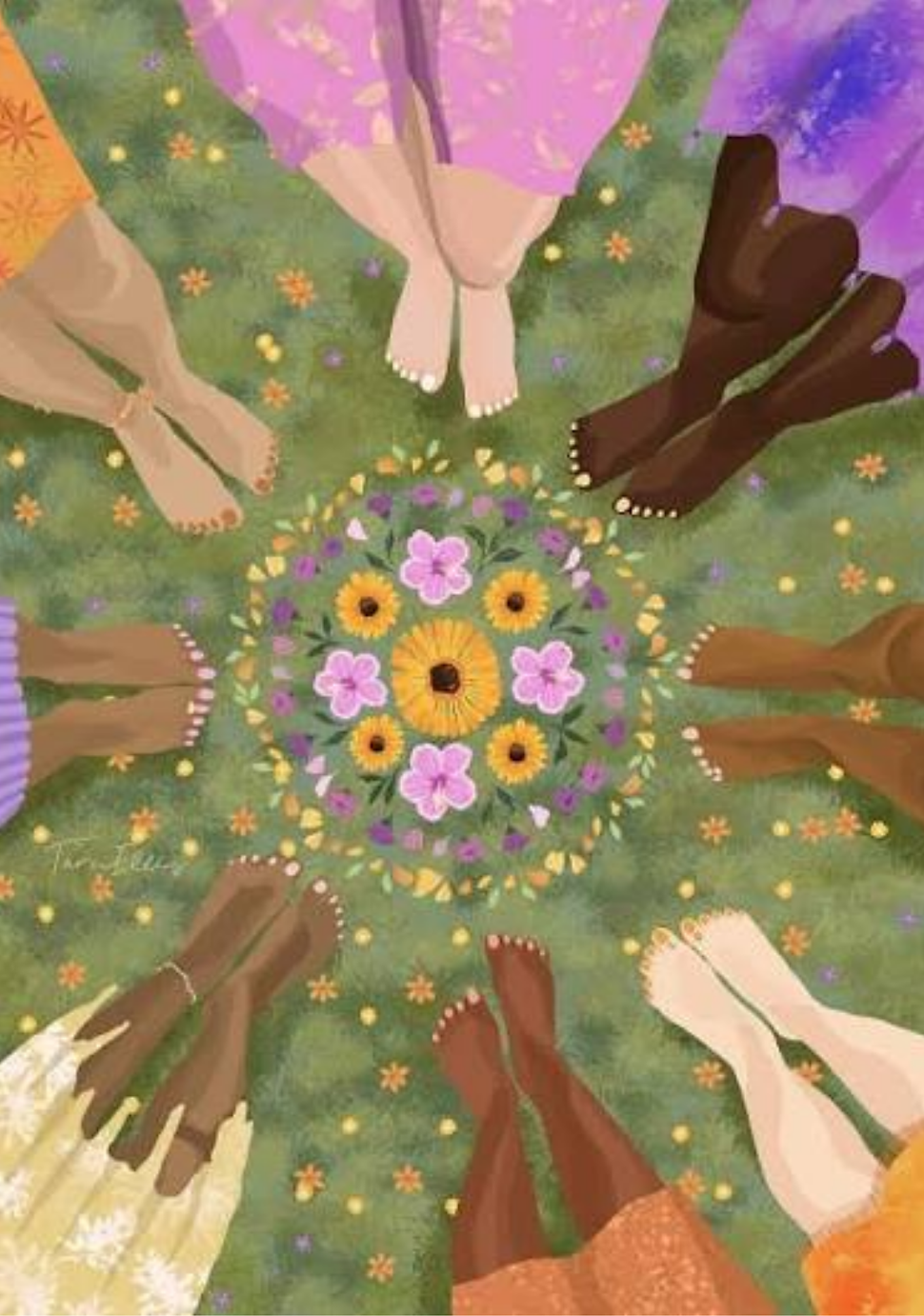
Flower Circle, Tarn Ellis
"The circles of women around us weave invisible nets of love that carry us when we're weak, and sing with us when we are strong.”
~Succulent Wild Woman,
Susan Ariel Rainbow Kennedy

Domestic Abuse Counselling in Maple Ridge, BC —
In-Person or Virtual
Sessions are available as in-person counselling in a private, welcoming office in Maple Ridge, BC, or as online counselling for those anywhere in British Columbia who prefer or need to connect from a safe location of their choosing. Whether you're searching for domestic violence support, a trauma-informed therapist, or confidential domestic abuse counselling, this is a space built around your safety and your pace. Please feel free to visit my FAQ for any questions regarding your sessions.
Other Ways I Can Support Your Family
The impact of domestic abuse rarely stays contained to one relationship — it can shape parenting, family dynamics, and the wellbeing of every person in the household. Depending on what your family needs, I also offer: